Cambridge Mobile Telematics
2023-2025
Openroad: From Crash Response to Prevention
Designing real-time feedback to help drivers recognize risky behavior before it led to a crash.

Role
Product Designer
Focus
Behavioral design · Experimentation · Real-time feedback
Team
PM, Behavioral Science, Data Science, Engineering
Platform
iOS and Android
~30K
Drivers included in testing
14%
Fewer hard brakes in 30 days
72%
Said the alerts positively influenced their driving
4
Product implementations
DRIVING DATA → INTERVENTION
Making an invisible behavior noticeable
Hard braking was a strong indicator of future crash risk, but detecting the behavior was only part of the problem. The experience had to intervene while someone was driving without creating another distraction.
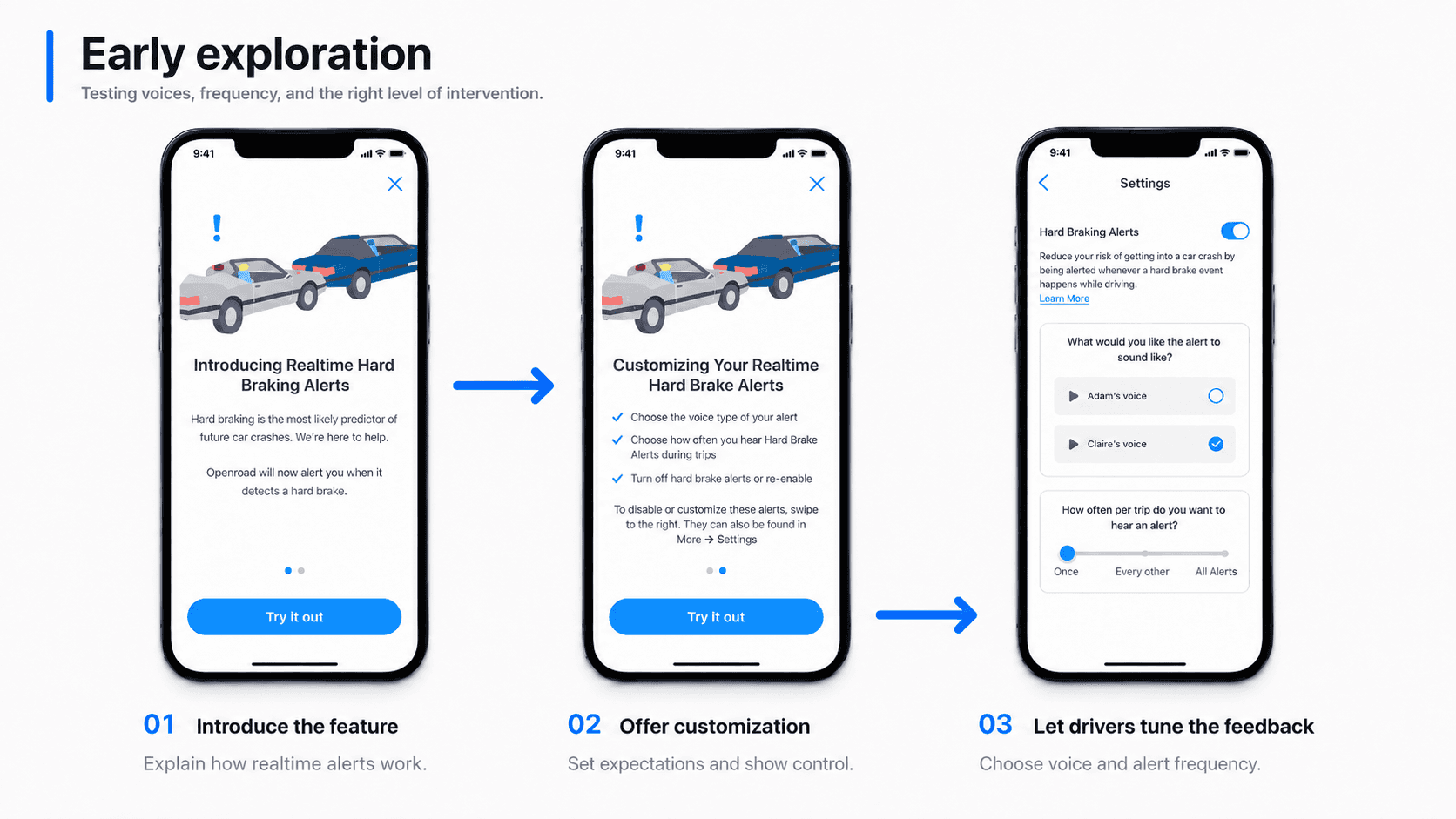
The first version was deliberately simple: introduce real-time Hard Brake Alerts, explain why they mattered, and give drivers a clear way to disable them.
We tested different activation approaches before recommending that alerts be enabled with an easy, accessible opt-out.
The goal wasn’t to make drivers study their behavior later. It was to create a moment of awareness while they could still adjust it.

A REMINDER, NOT A REPRIMAND
“Hard braking detected.”
The original spoken alert was clear, but users often experienced it as robotic, judgmental, repetitive, and potentially embarrassing with other people in the car.
That changed the design question from how clearly should we explain the event? to how little feedback does a driver actually need?
I explored voices, alert frequency, and eventually lightweight tones that only the driver needed to recognize. Instead of announcing a mistake, the sound could act as a private cue: that was a hard brake.
The bigger opportunity wasn’t choosing the right voice. It was removing the voice altogether.

HOW MUCH ASSISTANCE IS HELPFUL?
From one alert to a driving assistant
Once we knew real-time feedback could extend beyond a single alert, I explored what a broader safe-driving assistant might look like.
Otto grouped hard braking with speeding, weather information, audio preferences, and individual controls under one real-time assistance system.
The concept wasn’t only about designing an assistant. It gave us a way to test a larger product question:
How much intervention feels supportive before it becomes noise?
We also wanted to understand what users expected from the idea of a driving assistant, including needs we hadn’t anticipated ourselves.
Otto never shipped as a standalone product. As AI accelerated the conversation around assistants, we continued exploring the space, but the roadmap eventually shifted.

WHAT SCALED
What survived was the system, not the character
Otto never became a standalone product, but the underlying approach to real-time feedback continued to evolve.
Hard Brake Alerts became an optional capability in CMT’s white-label framework, where clients could choose to activate real-time feedback within their own programs. Tone customization also shipped beyond Openroad, turning what began as a single behavioral intervention into a more reusable pattern for driver feedback.
The work extended across Openroad, RoadClub, DriveScape and DriveWell Advance, along with customer and partner pilots.
THE TAKEAWAY
Designing for behavior change meant knowing when to say less
In a driving context, more explanation wasn’t always more helpful. The strongest feedback was immediate, recognizable, and easy to understand without demanding attention.
This work reinforced a principle I carried forward: intervene clearly, give people control, then get out of the way.
Good assistance isn’t about more intervention. It’s about the right intervention at the right moment.
Previous project
Next project